
Sweetheart table decor ideas: design the whole focal scene
Choose sweetheart table decor that fits your venue, guest view, setup plan, and budget with a five-layer focal-scene worksheet.
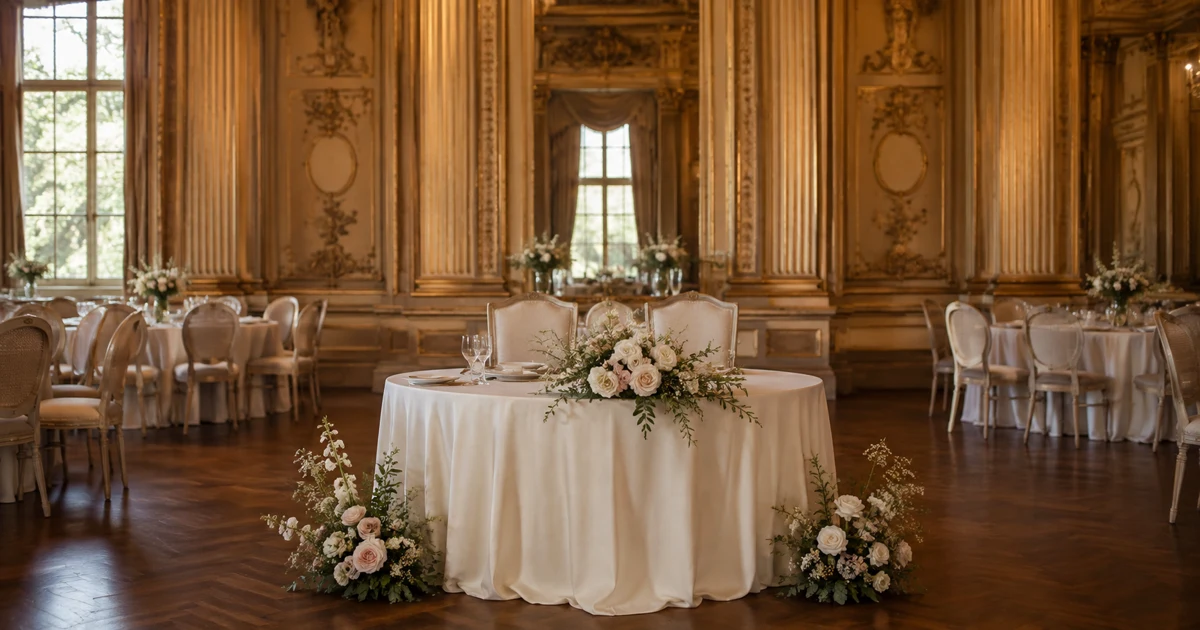
Choose sweetheart table decor by treating the area as one focal scene. Start with the venue backdrop and guest view, then decide whether the furniture, tabletop, floor treatment, or light needs more emphasis. Keep only the pieces that improve that full view and have a confirmed supplier, setup owner, possible reuse plan, and removal owner.
The table itself is only one layer. A decorated tabletop can still look unfinished against the wrong wall, while a strong fireplace, window, garden, or architectural feature may need almost nothing in front of it. Photograph the area from a guest’s view, audit five visual layers, and change the few that have a clear job.
Start with the room behind the table
Most sweetheart table inspiration begins with objects: flowers, linen, candles, chairs, signs, arches, or drape. Martha Stewart’s current roundup shows how varied the choices can be, but it also repeatedly connects them to the venue, scenery, furniture, and wedding aesthetic. The Knot’s sweetheart table ideas extend beyond the tabletop to backdrops, seating, floor arrangements, and reused ceremony structures.
That is useful inspiration, but the first decision happens before you choose any of those pieces. Stand where guests will enter the reception and photograph the proposed table area. Take another view from the middle of the room. Record what already appears behind, beside, and below the couple.
Look for:
- a wall, window, fireplace, garden, stage, curtain, door, or open view;
- existing furniture and the actual table the venue or supplier can provide;
- permanent light fixtures and the event-time lighting direction;
- nearby doors, service routes, speakers, railings, or other fixed features;
- decor already planned for adjacent guest tables, the dance floor, or the cake area.
A recent sweetheart and head-table planning question captures the problem neatly. The proposed heavy draping did not suit a grand gold and baroque hall. The missing step was not another drape idea. It was deciding how much work the venue was already doing.
Do not assume the proposed position, sightline, table, chair, attachment, flame, power source, or installation method is approved. Put every unresolved physical detail into the venue or supplier handoff before ordering it. The wedding venue decor restrictions checklist gives those questions a proper place.
Decide which of the five layers needs emphasis
Treat the sweetheart table as five connected layers. You do not need to decorate every one.
| Layer | What belongs here | Question to answer before adding anything |
|---|---|---|
| Backdrop | Existing architecture, scenery, approved frame, drape, flowers, or objects behind the couple | Does the current background already frame the couple, or does it contain a real distraction? |
| Furniture | Table, chairs, loveseat, linen, and any venue-provided platform | Does the supplied furniture fit the room and the way the couple will use the table? |
| Tabletop | Place settings, flowers, candles where permitted, menus, and small objects | What can add focus without blocking faces, conversation, place settings, or service? |
| Floor treatment | Arrangements, planters, lanterns, rugs, approved freestanding pieces, or nothing | Does the lower part of the scene need visual weight, and who will place and remove it? |
| Light | Existing room light plus any supplier-proposed decorative treatment | Which feature needs to remain readable at the event time, and who controls the light? |
Begin with the backdrop because it occupies the largest part of the view. If the venue has carved wall panels, a stone fireplace, a wide window, or an open landscape, hiding it may make the scene less specific to the room. If the background is visually busy or unrelated to the reception design, a supplier-proposed treatment may give the area a clearer boundary.
Then inspect the furniture. A different linen or pair of chairs can distinguish the couple’s table without building a new background. Tabletop decor should work at seated height. Floor pieces can add width or depth without filling the table. Light can help a chosen feature remain visible, but the responsible venue or supplier must determine the real equipment, position, control, power, and operating plan.
This is a subtraction exercise as much as a selection exercise. Once one layer carries the focal job, the others may only need to support it.
Complete the focal-scene worksheet
Use one row for each layer before requesting quotes or approving a supplier direction.
| Layer | Existing condition | Keep, change, or add | Visual job | Guest view | Couple and service use | Approval or source needed | Owner and next decision |
|---|---|---|---|---|---|---|---|
| Backdrop | [what is physically there] | [keep / change / add / undecided] | [frame, soften, simplify, add color, or none] | [what guests see from the room] | [access, seating, doors, service, or unknown] | [venue or supplier question] | [name, decision, date] |
| Furniture | [confirmed table, chairs, linen, or unknown] | [keep / change / add / undecided] | [distinguish, coordinate, add texture, or none] | [shape and visual weight in the full scene] | [seating and dining questions for the responsible supplier] | [inventory, dimensions, availability, approval] | [name, decision, date] |
| Tabletop | [planned place settings and decor] | [keep / change / add / undecided] | [focus, color, texture, or none] | [face and table visibility to review] | [place settings, meal service, conversation, or unknown] | [flame, placement, supplier scope, approval] | [name, decision, date] |
| Floor treatment | [floor, platform, existing objects] | [keep / change / add / undecided] | [ground, widen, connect, or none] | [full lower frame from guest positions] | [route, access, movement, cleanup, or unknown] | [placement, support, venue review] | [name, decision, date] |
| Light | [existing fixtures and event-time condition] | [keep / change / add / undecided] | [separate, warm, reveal, or none] | [how the focal area reads from the room] | [operator and scene changes, or unknown] | [supplier, venue, power, operating approval] | [name, decision, date] |
The visual job column keeps an appealing object from becoming an automatic purchase. If the answer is merely “make it special,” return to the wide venue photo. Name what the scene lacks. It may need contrast, a calmer background, a little width at floor level, or no intervention at all.
The couple and service-use column stops the photo from becoming the only view that matters. The two people still need to sit, eat, talk, stand, and leave the table. The responsible venue, caterer, planner, rental company, florist, and lighting supplier should review the details that fall within their work.
Keep uncertainty visible. “Unknown, ask the venue” is more useful than an invented measurement or an unconfirmed promise from an inspiration image.
Work through a hypothetical venue-fit example
Suppose the reception room is described as a grand hall with gold-toned baroque wall details, ornate sconces, a dark wood floor, and neutral dining chairs. The decorator’s first suggestion is heavy pale draping behind the sweetheart table.
This is a hypothetical text description. It is not a real venue, supplier proposal, NuptiaAI result, price, permission, or installation plan.
Start with the backdrop row. The room already has a visually strong wall, so the first candidate direction is to leave most of it visible. The drape remains undecided until the couple sees the actual guest view and asks what problem it would solve. If its only job is to create a focal point, a smaller change in the furniture, tabletop, or floor layer may do that without covering the room’s character.
The working comparison might look like this:
| Layer | Direction A | Direction B | What remains unresolved |
|---|---|---|---|
| Backdrop | Keep the baroque wall visible | Add a supplier-proposed drape treatment | Actual position, permitted method, full-room view, supplier scope |
| Furniture | Use the confirmed neutral chairs and distinguish the table with linen | Request different chairs and linen | Inventory, dimensions, comfort, availability, delivery, return |
| Tabletop | Use one restrained low treatment | Add a fuller table-front treatment | Place settings, service space, flower choice, placement, removal |
| Floor treatment | Leave the floor clear | Add approved freestanding pieces beside the table | Position, guest and staff movement, support, installation, removal |
| Light | Use the room’s existing sconces as the starting condition | Ask a responsible supplier for a focused treatment | Event-time test, equipment, power, operator, approval |
Nothing in this comparison proves that Direction A will look better. It does make the disagreement testable. Instead of debating whether drape is elegant, the couple can compare two full scenes against the room they booked and ask whether the added layer earns its cost and handling.
The final direction could mix rows. Keep the wall, use a more distinctive linen, add a restrained tabletop treatment, and leave the floor clear. Or keep the supplied furniture and add approved floor-supported pieces. The worksheet prevents the most expensive-looking option from winning by default.
Turn the chosen scene into a supplier handoff
Once a direction survives the full-room review, move every kept element into a handoff table. The wedding venue decor checklist separates supplier, owner, delivery, setup, reuse, and removal because those are different jobs. Apply the same discipline here.
| Element | Source or supplier | Confirmed specification | Written approval | Delivery | Setup | Possible reuse | Removal and return | Fallback |
|---|---|---|---|---|---|---|---|---|
| Backdrop treatment | [venue / rental / florist / other] | [current proposal or unknown] | [source, contact, date, conditions] | [owner and window] | [installer and room-ready time] | [destination, mover, time, receiver, or none] | [owner, deadline, collection] | [what happens if not approved or available] |
| Furniture and linen | [venue / rental / other] | [confirmed items and quantities] | [if required] | [owner and window] | [placement owner] | [if applicable] | [owner and return] | [confirmed substitute] |
| Tabletop treatment | [florist / rental / personal / other] | [current proposal] | [flame, placement, or other approval if relevant] | [owner and window] | [placement owner] | [destination and mover, or none] | [cleanup and collection owner] | [simpler approved version] |
| Floor treatment | [supplier] | [current proposal] | [placement and support review] | [owner and window] | [installer] | [destination and mover, or none] | [owner and deadline] | [remove the layer or use approved substitute] |
| Light | [venue / lighting supplier / other] | [supplier-proposed treatment] | [venue and supplier record] | [equipment arrival] | [installer and test time] | [not applicable or second scene] | [shutdown and collection] | [confirmed existing-light scene] |
Do not use “decorator” as the owner for every column unless that scope is written into the proposal. A florist may provide flowers but not move a ceremony structure. A rental company may deliver furniture but not place it. The venue may control installed lighting while an outside supplier controls added fixtures.
If a comparison produces several attractive directions, the handoff table is a useful tie-breaker. One option may depend on an unconfirmed structure, a separate delivery, and a move nobody owns. Another may use confirmed furniture and one supplier’s existing scope. That does not make the simpler direction automatically better, but it shows what each one asks of the day.
Treat ceremony reuse as a separate plan
Reusing ceremony decor behind or around the sweetheart table appears often in current inspiration coverage, including The Knot’s guide. It can make visual and financial sense, but “reuse the arch” is not a handoff.
Record the exact piece, its first and second locations, who prepares it to move, the route, the available time, the mover, the receiving person, the second setup, and the fallback. Ask the responsible supplier whether the real construction and decor treatment can move as proposed. If the piece cannot arrive on time or fit the second scene, know what the sweetheart table looks like without it.
The wedding arch decor guide covers the structure, focal-frame, setup, removal, and reuse decision in more depth. For sourcing questions, compare the real work in the rent-or-buy wedding decor guide before treating reuse or ownership as free.
Where NuptiaAI fits
NuptiaAI is an iPhone wedding-venue visualizer. It can use a reception photo with style, colors, event details, season, time, budget tier, flowers, and special requests.
Use the same wide source photo to compare controlled sweetheart table directions. Keep the room, table position, and most inputs steady. Change the backdrop treatment, furniture emphasis, tabletop density, or floor treatment one at a time. That makes the visual difference easier to inspect.
Treat each result as a concept. NuptiaAI cannot decide the floor plan, confirm sightlines or dimensions, preserve exact architecture, verify attachments or flames, plan access, confirm supplier stock, specify installation, assign reuse labor, approve a physical layout, or provide a final price. A generated image may also invent a support, flower, light, opening, piece of furniture, or architectural detail. Compare it with the source photo and keep every buildable decision in the venue and supplier handoff.
Frequently asked questions
What goes on a sweetheart table?
Start with the two place settings and anything required for dinner service. Add tabletop decor only when it has a clear job in the full scene, such as introducing color or connecting the table with the rest of the reception. Confirm flowers, objects, candles, signs, and placement with the suppliers and venue responsible for them. Keep faces, conversation, and service in the review.
Does a sweetheart table need a backdrop?
No. First photograph the actual view behind the table. A fireplace, window, garden, detailed wall, curtain, or other venue feature may already frame the couple. Add a backdrop only when it solves a named visual problem and its specification, permission, installation, timing, and removal are resolved.
How can a sweetheart table stand out without heavy decor?
Choose one layer to carry the emphasis. A distinct linen, confirmed furniture choice, restrained tabletop treatment, approved floor-supported arrangement, or supplier-planned light can separate the area without changing every layer. Judge it from the guest view, not only in a close photograph of the table.
Can ceremony decor be reused at the sweetheart table?
Yes, when the responsible suppliers confirm that the real piece can move and the schedule supports it. Record the first and second locations, route, mover, timing, receiving person, second setup, and fallback. If those fields are blank, keep the ceremony and reception plans independent.
Who is responsible for sweetheart table setup and removal?
The answer comes from the current venue terms and supplier scopes. Assign one named person or team to delivery, setup, any reuse move, cleanup, removal, and return. Do not assume the company that supplies an item also places, moves, or collects it.
Use the NuptiaAI wedding decor guides to compare the focal direction, then keep the selected concept beside the confirmed venue and supplier handoff.