
Wedding Aisle Decor Ideas: Plan the Entrance, Rhythm, and Focal Point
Choose wedding aisle decor by what the entrance, processional path, and ceremony focal point need, then plan setup, reuse, and removal.
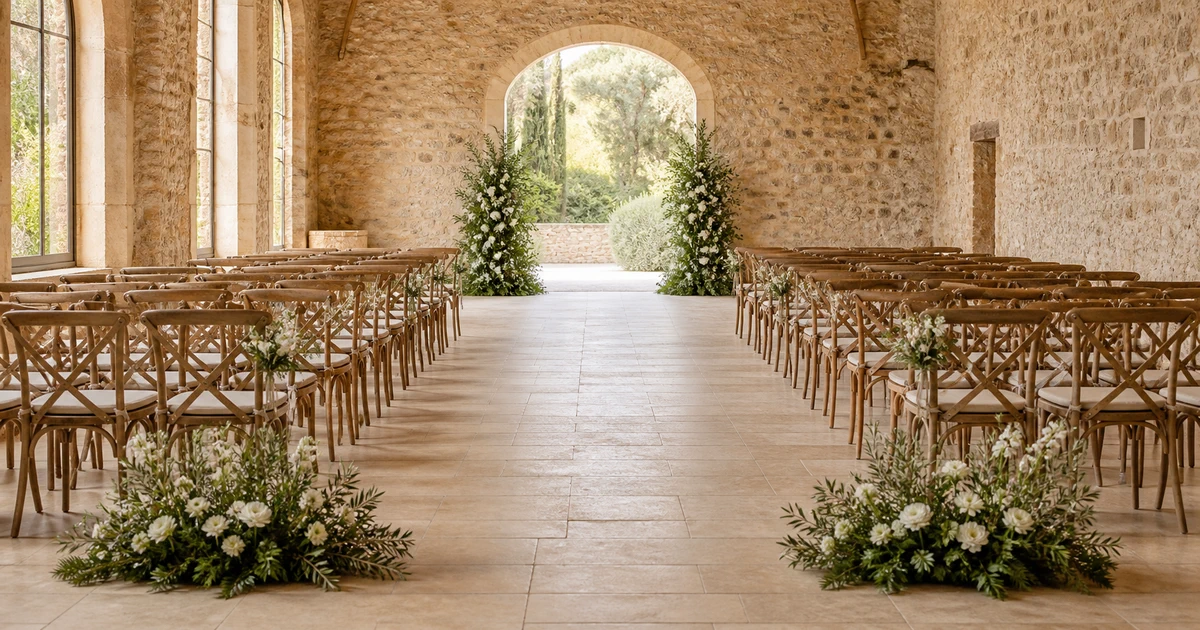
Plan wedding aisle decor in three zones: the entrance, the repeated rhythm along the path, and the ceremony focal point. Give one zone the strongest treatment, let a second support it, and leave the third quiet when the venue already supplies enough visual interest. Score each idea for venue fit, setup, reuse, removal, and whether it supports the processional before ordering it.
That approach is more useful than collecting 60 unrelated aisle pictures. A pair of arrangements at the entrance, a few repeated chair details, and a strong existing backdrop may be enough. Another ceremony may need an almost bare entrance, a runner that defines the path, and one concentrated focal treatment. The right choice depends on what the real ceremony view is missing.
Plan the entrance, rhythm, and focal point
Current search results offer a large visual vocabulary. The Knot’s aisle decor gallery includes runners, flowers, greenery, candles, chair and pew details, fabric, and venue-specific examples. It also shows ceremonies where minimal aisle decor leaves strong architecture or a backdrop visible. Paperlust’s 2026 guide groups ideas by decor level, venue, budget, and reuse.
Use those pages for inspiration, then give each part of your aisle one job.
| Zone | Job | Directions to test | When to leave it quiet |
|---|---|---|---|
| Entrance | Mark the start of the processional and establish the first frame | A pair of arrangements, planters, permitted lanterns, fabric details, a runner beginning, or the existing doorway | The entrance already has character or the ceremony focal point needs the emphasis |
| Rhythm | Connect the entrance to the ceremony through deliberate repetition | Selected chair or pew markers, spaced floor arrangements, a runner, a permitted edge treatment, or an intentionally bare path | Repetition would distract from the processional, duplicate a strong runner, or create too much handling |
| Focal point | Give the processional a clear destination and frame the ceremony | Existing architecture or scenery, paired floor-supported arrangements, a venue-provided structure, a permitted backdrop, or concentrated decor | The venue already supplies a strong focal feature or a new structure would compete with the people and setting |
Choose one dominant zone. Let another repeat one material, color, or shape more quietly. The third zone can stay undecorated. This is a hierarchy, not a requirement to buy something for every section.
If the broad style still fights the room, use the venue-fit wedding decor scorecard before choosing aisle objects.
Choose ideas for the aisle entrance
The entrance is the transition from guest seating to the processional. It can carry the design when the path itself should remain simple.
Ideas to test include:
- A pair of floor arrangements. Concentrate flowers, foliage, or another permitted material at the start instead of repeating it down every row.
- Planters or potted material. Use them only after the real containers, bases, handling, and venue conditions are confirmed.
- Lantern or light groupings. Keep the visual idea pending until the venue and responsible supplier confirm the light source, placement, power or flame conditions, setup, and collection.
- Fabric on the first chair or pew ends. Repeat a material already used at the focal point without dressing every row.
- A runner beginning. Let the start of the runner provide the entrance line rather than adding a second cluster around it.
- The existing doorway or view. If the entrance already frames the processional, leave it visible.
A paired arrangement is a visual direction, not an installation instruction. Record the footprint, support, supplier, setup owner, and removal plan for the actual item.
Create rhythm without filling every row
Rhythm tells the eye that the entrance and ceremony belong to the same path. It comes from repetition, but repetition does not have to mean an identical marker on every chair.
Try one of these patterns in the real ceremony view:
- markers on selected rows rather than every row;
- alternating floor pieces with clear undecorated gaps;
- one continuous runner with little or no edge decor;
- a low edge treatment proposed by the responsible supplier;
- fabric, ribbon, or greenery on the aisle-side chair or pew ends where the venue permits it;
- the same small material or color note repeated at the entrance and focal point, with the middle left mostly clear;
- no path decor when the chairs, floor, landscape, or architecture already define the aisle.
Judge the pattern from both ends. The guest sees the processional toward the focal point. The people entering see the full aisle ahead of them. A detail that looks balanced in a close photograph may turn into visual noise across twenty rows.
Do not use a mood board to settle the real path. Give the current layout and proposed item positions to the venue or responsible professional so they can check walking clearance, accessibility, sightlines, support, and any ceremony-specific requirement.
Concentrate decor at the ceremony focal point
The focal point is where the processional leads. If it already has a window, fireplace, tree, view, architectural opening, religious feature, or venue-provided structure, the strongest choice may be to frame that feature rather than cover it.
Directions to compare include:
- two arrangements on approved floor-supported stands;
- a venue-provided arch or structure with an approved treatment;
- a permitted freestanding backdrop proposed by its supplier;
- a concentrated flower or non-floral treatment with a quiet aisle;
- existing architecture with only a small entrance or rhythm detail;
- no added structure when the setting already provides a clear frame.
Keep the focal treatment connected to the aisle. Repeat one material or color at the entrance, or let a runner point toward it. Avoid starting a separate theme at the front merely because the supplier gallery offers another package.
For a full material framework, see the guide to wedding decor without flowers. It separates visual jobs such as focus, height, softness, color, and atmosphere from the materials used to perform them.
Score each idea before keeping it
Use a five-part score to compare candidate ideas. Give each dimension 0, 1, or 2 points.
- 0: the work or decision is unknown.
- 1: a plausible direction exists, but written confirmation or a named handoff is missing.
- 2: the current source, responsible party, timing, and handoff are recorded where relevant.
| Idea | Venue fit | Setup | Reuse | Removal | Processional focus | Total / 10 | Next unresolved decision |
|---|---|---|---|---|---|---|---|
| [item and zone] | [0-2] | [0-2] | [0-2] | [0-2] | [0-2] | [sum] | [decision, owner, deadline] |
Venue fit covers the current venue source, included inventory, floor or furniture condition, and written approval status. Setup covers the supplier, arrival, installation owner, and available window. Reuse needs a real second location, move time, route, and mover. Score it 2 when you have deliberately decided not to reuse the item. Removal needs a collection owner and deadline. Processional focus asks whether the item has a clear entrance, rhythm, or focal-point job and whether the real ceremony layout has been checked by the responsible people.
The score measures planning resolution. It does not prove that an item is safe, accessible, stable, permitted, structurally suitable, or worth its price. A low total tells you which question to answer next. It should not tempt you to solve a physical or venue decision yourself.
Turn the selection into a setup, reuse, and removal plan
An aisle idea is not finished when the florist or rental company can supply it. Follow it through the ceremony.
For every item you keep, record:
- the exact item, zone, and visual job;
- the current venue source or written approval;
- the proposed location, dimensions, footprint, support or attachment, and flame or power details when relevant;
- the supplier, delivery route, receiving person, setup owner, and completed-by time;
- the person who compares the installed aisle with the approved layout and sends unresolved path, sightline, or access questions to the venue or responsible professional;
- the second location, move time, route, mover, and receiving person when the item will be reused;
- the collection owner, removal deadline, packaging or transport plan, and final destination;
- the venue and supplier decision for an outdoor weather change when relevant.
Reuse is only useful when the move is real. “Take these to the reception” is not enough. The ceremony may still be in progress when another space needs to be ready, or the person named in your head may be occupied elsewhere. Write the handoff down.
The broader wedding venue decor checklist tracks the same kind of ownership across arrival, ceremony, cocktail hour, reception, and exit.
Check venue rules before buying
A runner, candle, petal path, chair marker, or backdrop can look ordinary in an inspiration photo and still conflict with a particular venue’s policy.
Pathway Community Church’s current wedding policy gives a concrete example. At that venue, decoration must fit the scheduled reservation period and the space must be cleared within one hour after the ceremony. The policy prohibits tape, tacks, and nails on walls or doors. Couples provide their own runner if they choose one. Pathway permits dripless candles on the stage and on stands down the aisles, but not candles for individual guests. It prohibits throwing real flower petals.
Those are Pathway Community Church’s rules. They do not tell you what another church, hotel, garden, beach, barn, or private property permits. Their value is the list of questions they expose: setup window, removal deadline, attachment method, runner responsibility, flame, and petals.
Use the wedding venue decor restrictions checklist to record your venue’s current answer, approver, conditions, and design consequence. Keep an idea pending until the real item and method are approved.
Where NuptiaAI fits
NuptiaAI is an iPhone wedding-venue visualizer. It can use a ceremony-space photo with style, colors, event details, season, time, budget tier, flowers, and special requests.
Use the same wide ceremony photo to compare one controlled decision at a time. One concept can put the emphasis at the entrance. Another can keep the middle quiet and concentrate decor at the focal point. A third can test a restrained rhythm along selected rows. This makes the difference easier to inspect than a prompt asking for every saved idea at once.
Treat each result as a visual hypothesis. A generated image can add unrequested petals or candles, invent attachments, change a runner, narrow the path, move chairs, or alter the architecture. NuptiaAI cannot verify dimensions, walking clearance, accessibility, support, anchoring, flame or petal rules, weather, installation, venue permission, supplier availability, or price. Compare the concept with the source photo and the written venue record before it reaches a supplier.
Frequently asked questions
Do you need a wedding aisle runner?
No universal rule requires one. A runner can define the processional line or change how an existing floor reads, but a bare approved surface may already work. Confirm the venue’s floor, runner policy, responsibility, installation, and removal before ordering. Pathway Community Church, for example, makes the couple provide the runner if they choose one. That condition belongs only to that venue.
How can you decorate a wedding aisle without flowers?
Use the same three-zone plan with other permitted materials or with the venue itself. Fabric on selected chair ends can create rhythm. Lanterns with an approved light source can mark an entrance. A runner can define the path. Existing architecture, screens, objects, or a floor-supported treatment can frame the ceremony. Choose the visual job first, then confirm the real material and installation.
How much wedding aisle decor do you need?
Enough to give the processional a clear hierarchy. Start with one dominant zone and one quieter supporting repeat. If the entrance, path, and backdrop already read clearly, stop. If the scorecard exposes unresolved setup and removal work for details that barely change the full ceremony view, remove those details before adding more.
How do you stop aisle decor from looking cluttered?
Repeat fewer materials and vary the concentration. Put the strongest treatment at the entrance or focal point, then use wider gaps or a quieter version along the path. Review a wide view from both ends of the aisle. Close photographs hide repetition that becomes busy across the full ceremony layout.
Are candles and petals allowed in a wedding aisle?
That depends on the venue, the exact item, the method, and current written rules. Do not infer permission from a photograph or another venue’s policy. Send your venue the candle type and position or the petal material and use, then record the answer. Pathway Community Church permits certain dripless candles and prohibits throwing real petals, but another venue may use a different rule.
Use the NuptiaAI wedding decor guides to compare the visual direction, then keep the selected aisle plan beside the venue approval and supplier handoff.