
Wedding arch decor ideas: decide what the ceremony needs
Choose a venue-provided arch, rental frame, or no-structure focal point by comparing the real backdrop, people, setup, removal, and reuse.
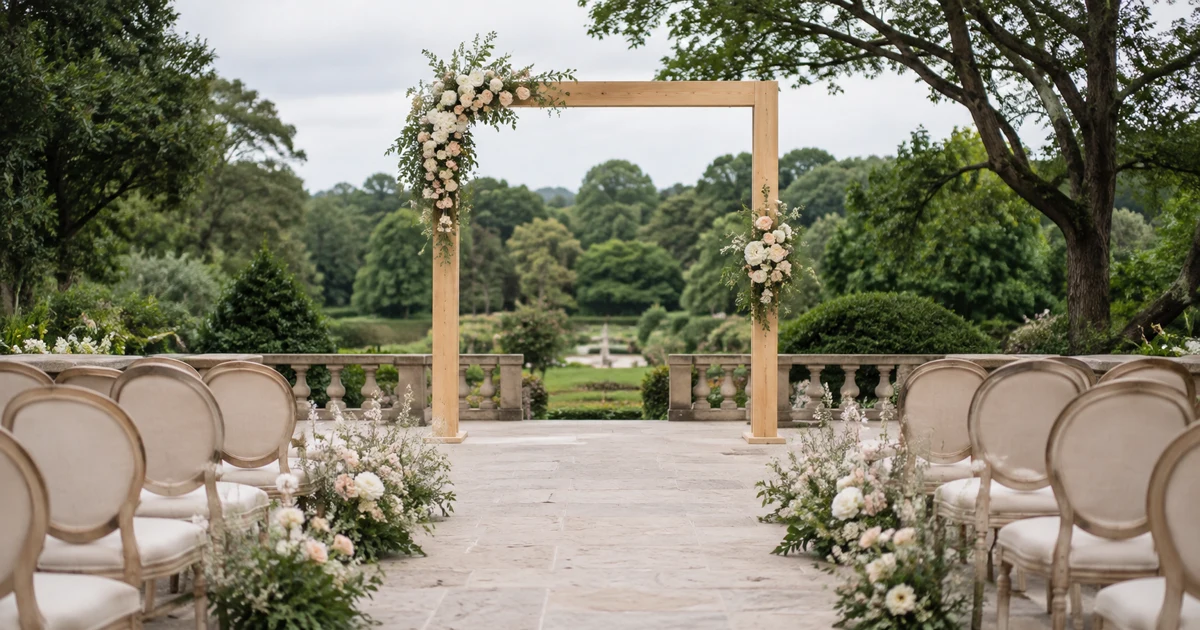
Choose wedding arch decor by starting with the real ceremony view. Decide whether the existing backdrop already frames the couple, then compare three branches: decorate a venue-provided frame, bring in a supplier-approved rental frame, or use no structure and concentrate approved decor at floor level. Keep only the option that improves the full view and has a real setup, removal, and reuse plan.
An arch can add shape, contrast, color, or a clear destination at the end of the aisle. It can also cover the landscape, compete with the venue, squeeze the people into the wrong visual frame, or create more handling than the ceremony needs. Ask what is missing from this ceremony view, then decide whether a structure is the best way to add it.
Decide whether the ceremony needs an arch
Photograph the empty ceremony position from the center aisle, the guest seating area, and the likely camera positions. Mark what should stay visible. That may be a garden, water, mountains, a stone opening, a tree, a fireplace, a window, or a venue-provided frame.
Then follow this short decision tree:
- Does the existing backdrop already create a clear focal point? Test a no-structure plan first. Leave the view open, or compare it with an approved pair of floor-supported arrangements.
- Does the venue supply a frame that suits the view? Photograph that exact structure and ask what may be added, where, by whom, and within which setup and removal window.
- Would a new frame solve a specific visual problem? Ask a rental or design supplier for a proposal tied to the real position, venue conditions, installation, and removal.
- Is the physical plan still unresolved? Keep the no-structure option as the fallback. A saved inspiration image is not approval.
A recent wedding-planning discussion about skipping an arch captures the real tension. The outdoor view already looked strong, but the author worried that the ceremony and photographs might feel empty without the familiar frame. That is a visual decision worth testing. The replies are personal opinions, not installation or photography rules.
If your ceremony requires a particular structure for cultural or religious reasons, begin with the appropriate officiant or community authority as well as the venue and responsible suppliers. Its meaning and physical requirements should not be reduced to a generic decor choice.
Choose a venue-provided, rental, or no-structure branch
The three branches may lead to a similar photograph, but the work behind them is different.
Decorate a venue-provided frame
Start with the structure that will actually be present. Record its location, visible finish, current condition, dimensions supplied by the venue, and the features behind it. Ask the venue to identify the permitted decor area, review method, access limits, installer requirements, setup window, and removal deadline.
The Delanie’s current venue FAQ is one concrete example. That venue permits decor on its ceremony arch within a stated ladder-reach limit. It requires unapproved items to receive approval and makes the client remove floral arch decor within the cleanup period. Those are The Delanie’s conditions. They do not establish the permitted height, attachment method, access, timing, or approval process at another venue.
A venue-provided frame can save the need for another structure, but it is not blank property. Build the visual direction inside the venue’s current rules and the supplier’s real scope.
Bring in a rental frame
Choose a rental frame only after naming the job it will do. Perhaps the open room needs a stronger boundary around the people. Perhaps the backdrop needs contrast. Perhaps an asymmetrical frame leaves more of the view visible than a full rectangle.
Give the supplier the ceremony position, venue plan, wide photographs, surface, weather context, people in the frame, and intended treatment. Ask that supplier and the venue to resolve the actual frame, placement, support or anchoring, transport, access, installation, weather decision, and removal. Do not reverse-engineer those decisions from a photograph of another wedding.
Use no structure
The existing view may already be the focal point. Approved floor-supported arrangements, planters, objects, or a restrained fabric or flower treatment on an existing venue feature may add enough definition without placing a new outline behind the ceremony.
Keep the same questions. Who supplies each item? Where does it sit in the current ceremony plan? Who reviews the placement and access? Who installs and removes it? Freestanding does not mean automatically suitable.
For the full path from the entrance to the ceremony position, use the wedding aisle decor guide. It helps you decide whether the entrance, repeated rhythm, or focal point should carry the strongest treatment.
Match the decor idea to the job
The Knot’s current wedding arch gallery shows the visual range: venue-built stone and metal features, rectangular wood frames, circles, triangles, detached forms, asymmetrical flowers, greenery, fabric, and reused structures. It also advises readers to consider the venue, ground, weather, placement, professional setup, and reuse.
Use that range as vocabulary. Choose the job first.
| What the ceremony view needs | Directions to compare | What to protect |
|---|---|---|
| A clear boundary around the people | An open rectangular or curved frame, a venue-provided opening, or a restrained rental structure | Enough visual room for the couple, officiant, and wedding party in the real plan |
| More contrast against a busy backdrop | A simpler silhouette, controlled color, fabric, or a concentrated flower treatment | The backdrop details worth keeping and the people as the main subject |
| More of the landscape left visible | A partial, detached, or asymmetrical frame, paired floor treatments, or no structure | The horizon, garden, water, architecture, or view that made the venue appealing |
| Softness around a hard architectural edge | Fabric, flowers, foliage, or another approved material proposed for the exact feature | The surface, permitted method, access, material behavior, and removal conditions |
| A focal point without flowers | Fabric, permitted lighting, objects, greenery, potted material, or a strong undecorated structure | Venue rules, supplier method, power or flame review when relevant, and the full ceremony view |
| A treatment that may move later | A structure or modular decor proposed for a named second location | Construction, move route, timing, labor, receiving person, second setup, and fallback |
For a fuller material framework, see wedding decor ideas without flowers. That guide separates visual jobs such as focus, height, softness, color, texture, repetition, and atmosphere from the material used to perform them.
Score the whole focal frame
Score each candidate direction from 0 to 2 on eight dimensions. A 0 means the view or handoff has not been checked. A 1 means the direction looks plausible, but a source, decision, or owner is missing. A 2 means the current source and responsible owner are recorded, and the visual decision is resolved enough to compare with the alternatives.
| Dimension | What earns 2 points |
|---|---|
| Existing backdrop | The feature is deliberately framed, softened, or left visible |
| People in the frame | The responsible team has reviewed the real group and standing plan with the design |
| Shape and scale | The choice is tied to the actual venue-provided or supplier-proposed structure |
| Visual density | The treatment has one clear job and keeps the people and venue legible |
| Ceremony placement | The position is marked in the current ceremony plan and reviewed by the responsible parties |
| Photography | The design has been reviewed from the center aisle and other planned camera positions |
| Setup and removal | Delivery, installation, room-ready time, removal, and collection have named owners |
| Realistic reuse | The second location, route, mover, timing, receiving person, and fallback are recorded, or reuse is deliberately declined |
Now compare the three branches:
| Candidate direction | Backdrop | People | Shape and scale | Density | Placement | Photography | Setup and removal | Reuse | Total / 16 | Next unresolved decision |
|---|---|---|---|---|---|---|---|---|---|---|
| Venue-provided frame | [0-2] | [0-2] | [0-2] | [0-2] | [0-2] | [0-2] | [0-2] | [0-2] | [sum] | [decision, owner, date] |
| Rental frame | [0-2] | [0-2] | [0-2] | [0-2] | [0-2] | [0-2] | [0-2] | [0-2] | [sum] | [decision, owner, date] |
| No structure | [0-2] | [0-2] | [0-2] | [0-2] | [0-2] | [0-2] | [0-2] | [0-2] | [sum] | [decision, owner, date] |
The score measures planning resolution. It does not certify taste, stability, access, structural safety, weather readiness, flower durability, permission, or value. A lower score tells you which question is still open.
Review the people, backdrop, and camera views together
An empty arch can look balanced and still make the live ceremony awkward. Add the actual people and positions to the review. The couple, officiant, attendants, readers, musicians, ceremony table, and any required ritual objects may all change how much frame and decor the scene can carry.
Review a wide mockup or supplier drawing from the center aisle and the likely side angles. Ask the photographer or planning team which views matter, while keeping final placement with the venue and responsible suppliers. Check whether the frame hides a feature you wanted, creates a distracting line behind a face, leaves one person visually outside the treatment, or becomes so dense that the people disappear into it.
This is also where “more flowers” often turns out to be the wrong instruction. The scene may need a clearer silhouette or a quieter background, not more material. Compare a light treatment, a concentrated asymmetrical treatment, and the no-structure branch before filling the whole frame.
Plan setup, removal, and realistic reuse
An arch idea is unfinished until someone owns the physical handoffs. Record:
- the selected venue-provided, rental, or no-structure branch;
- the exact visual job and marked ceremony position;
- the current venue source, supplier proposal, and written approval;
- the supplier, installer, delivery route, access plan, and room-ready time;
- the person who checks the installed scene against the approved plan;
- the removal start time, owner, packaging, route, deadline, and final destination;
- the second location, mover, move time, receiving person, setup instructions, and fallback if the decor will be reused.
Reuse can be worthwhile, but only when the move fits the day. A frame that must be disassembled, moved through a guest route, restyled, or installed while the reception space is in use needs more than “move it after the vows.” Ask the responsible supplier whether the proposed construction and treatment can make that move, then name the people and times at both ends.
If the venue declines the structure, attachment, access plan, weather plan, or timing, use the recorded fallback. The wedding venue decor restrictions checklist gives you a broader worksheet for attachments, flame, power, access, supplied inventory, cleanup, outdoor conditions, and written approval.
Where NuptiaAI fits
NuptiaAI is an iPhone wedding-venue visualizer. It can use a ceremony-space photo with style, colors, event details, season, time, budget tier, flowers, and special requests.
Use the same wide source photo to compare one controlled focal decision at a time. Try the existing backdrop with no structure, a restrained treatment on the real venue-provided frame, or the visual direction of a supplier-proposed rental. Keep the people space, camera view, and other decor inputs consistent so the focal change is easier to inspect.
Treat every result as a concept. A generated image may invent a frame, attachment, flower, support, or view. It may change the architecture, floor, chairs, aisle, or proportions. NuptiaAI cannot verify measurements, sightlines, placement, anchoring, weight, wind, weather, attachments, flower durability, transport, labor, structural safety, installation, venue approval, supplier stock, or price. Compare the result with the source photo and send the selected direction back to the venue and responsible suppliers.
Frequently asked questions
Do you need a wedding arch?
No. You need a clear ceremony focal point, but the venue may already provide one through architecture, landscape, a tree, a fireplace, a window, or a supplied frame. Compare the wide view with and without a new structure. Keep the arch only if it improves that real scene and the physical handoff is resolved.
What can you use instead of a wedding arch?
Use the existing backdrop, a venue-provided feature, or an approved floor-supported treatment. Paired arrangements, planters, objects, fabric on a permitted existing feature, or a clear undecorated view can define the ceremony position. The venue and responsible suppliers still need to review the real item, placement, access, setup, and removal.
How much decor should go on a wedding arch?
Enough to perform one named job. A light treatment may soften the frame. A concentrated asymmetrical treatment may add color while leaving the view open. A fuller treatment may create contrast in a plain space. Compare each option in the wide ceremony view, not only in a close crop, and stop when more material starts competing with the people or backdrop.
Can you reuse a wedding arch at the reception?
Only when the real structure and treatment can be moved within a documented plan. Confirm the second location, route, mover, timing, receiving person, setup instructions, and fallback with the venue and responsible supplier. If those details do not fit the day, reuse the removable decor elsewhere or leave the arch in place according to the approved plan.
Who should set up and secure a wedding arch?
The venue and the suppliers responsible for the structure and decor should decide who designs the method, supplies the equipment, installs it, reviews it, and removes it. Do not infer the method from a tutorial or inspiration photo. Give the team the exact frame, treatment, position, site conditions, schedule, and venue requirements.
Use the NuptiaAI wedding decor guides to compare the focal direction, then keep the selected concept beside the venue approval and supplier handoff.