
Wedding Reception Lighting Ideas: Choose by What the Room Needs
Match reception lighting to flat walls, dark tables, high ceilings, focal points, and outdoor transitions, then take a clear approval brief to your venue and lighting supplier.
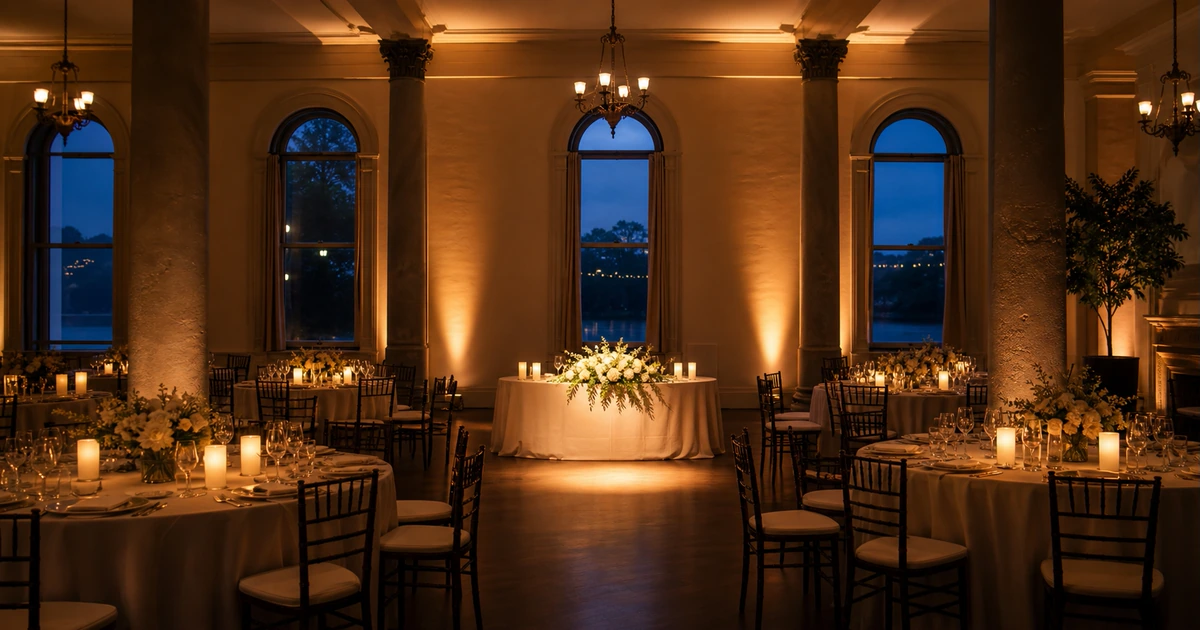
Choose wedding reception lighting by the problem the room needs to solve. Uplighting can give plain walls more visual depth, pin spots can draw attention to a centerpiece or focal area, overhead strings or pendants can bring visual interest to a tall room, and table-level light can support a more intimate atmosphere. Before choosing equipment, confirm the venue’s installed lighting, attachment rules, flame policy, power, supplier access, setup window, and who will operate the final system.
A list of pretty lights is useful for inspiration, but it does not tell you what your reception needs. Start with the guest view at dinner, speeches, and dancing. Decide whether the problem is a flat room, a lost focal point, a high ceiling, poor table visibility, or a difficult transition to an outdoor area. Then ask the venue and the responsible lighting supplier to turn that visual direction into a real plan.
Start with the lighting already in the venue
Ask the venue to show you the reception room in the settings it will use during your event. Find out which fixtures can be dimmed or switched separately, who controls them, and whether their settings change after dinner. Photograph the room only where the venue permits, and write down what remains unknown.
Record:
- installed ceiling, wall, table, stage, and dance-floor lights;
- dimming or scene controls and the person allowed to operate them;
- daylight at the time guests arrive and when the room will be fully dark;
- fixed walls, columns, windows, drape, and architectural features that could receive accent light;
- areas that need attention during dinner, speeches, cake cutting, and dancing;
- venue-provided lighting equipment and any separate fee or supplier requirement.
The Knot’s current reception-lighting guide shows the broad visual vocabulary couples will encounter: candles, uplights, string lights, chandeliers, spotlights, and colored dance-floor lighting. Treat those as directions to explore. The actual fixture type, quantity, position, output, control, and installation belong in the venue and supplier plan.
Use a problem-to-lighting decision matrix
This matrix is an original planning tool, not an illumination calculation or installation specification. Use it to turn “we want the room to feel warmer” into a smaller set of questions that a venue and lighting professional can answer.
| What the room needs | Direction to explore | What to preserve | What to confirm before approval |
|---|---|---|---|
| Plain walls or a flat-looking room | Uplighting or a restrained wall wash | Wall texture, venue colors, doors, signs, and architectural detail | Allowed fixture positions, power or battery method, cable routes, color and brightness control, setup, and operator |
| A focal point that disappears into the room | Pin spots or other focused accent lighting | The couple’s table, cake, flowers, art, or architectural feature you actually want noticed | Fixture and mounting location, aim, spill onto guests or reflective surfaces, control, access, and supplier |
| A tall room that feels visually empty overhead | Existing chandeliers, venue-approved pendants, string lights, or a ceiling treatment designed by a supplier | Ceiling architecture, sprinklers, signs, sightlines, and the room’s sense of scale | Whether suspension is allowed, approved attachment or rigging method, installer, access equipment, power, setup, and removal |
| Tables that feel disconnected from the rest of the room | A layered plan combining the installed system with permitted table-level or nearby ambient light | Clear place settings, conversation, service space, and the chosen table design | Whether guests and staff can comfortably use the tables, permitted flame or power source, placement, controls, cleanup, and backup |
| One dark corner or transition area | Local accent lighting, a permitted practical lamp, or targeted venue lighting | Doors, service paths, furniture, and any useful existing feature | Outlet or battery plan, cables, floor footprint, controls, access, and who moves or removes the equipment |
| An outdoor, tent, terrace, or garden transition | Venue-approved path, perimeter, canopy, or landscape lighting planned for the site | Entrances, routes, landscape, tent structure, and the change from daylight to night | Weather and site suitability, attachment points, power, cable protection, supplier access, operating plan, and wet-weather alternative |
A reception rarely needs one idea from every row. Pick the one or two problems that matter most, then leave the rest alone. A room with attractive installed chandeliers may need only a clearer focal point. A blank hall may benefit more from a wall treatment than from another object on every table.
Wedding reception lighting ideas by job
Use uplighting when the walls need depth
Uplights sit low and direct light upward onto a wall, column, drape, or architectural surface. They are worth exploring when a broad perimeter feels visually flat or when you want to repeat one restrained color around the room.
Test the direction on the actual venue finishes. Brick, stone, mirrors, pale drape, dark paint, and patterned walls will not respond in the same way. Ask the supplier to test or explain how the proposed fixtures affect doorways, signs, faces near the wall, and photography before you approve a full-room plan.
Use focused light when one feature needs attention
Pin spots and other narrow accent lights can separate a centerpiece, cake, floral installation, couple’s table, or piece of architecture from the surrounding room. Use them when the problem is focus, not general brightness.
Decide what deserves attention before asking for fixtures. Lighting every decorative object can flatten the hierarchy again. The supplier should confirm where the equipment can be positioned, how it is aimed, who adjusts it after setup, and whether the target will move during the event.
Use overhead lighting only after checking the structure
String lights, pendants, chandeliers, and suspended fixtures can create an overhead plane in a tall room or tent. They also introduce attachment, access, power, labor, and removal questions that do not appear in an inspiration image.
An existing beam, hook, pole, tree, ceiling grid, or tent member is not permission to use it. Send the venue the exact proposed equipment, location, support method, installer, access plan, and removal time. If overhead installation is not allowed, use the no-hanging wedding venue guide to bring visual weight down to walls, floors, tables, and approved freestanding elements.
Treat candles and table lights as one layer
Candles, flameless lights, small lamps, and other table-level sources can add repetition and a close, warm atmosphere. They still need to fit the table layout, venue rules, service plan, cleanup, and the broader lighting system.
A styled photograph cannot show whether table light is sufficient for dining, movement, or staff work. Ask the venue and supplier what provides the usable base light, then treat the table layer as part of the atmosphere unless they specify otherwise.
Give the dance floor its own scene
Dinner and dancing ask the room to do different jobs. A controlled change in color, focus, or movement can make that transition readable without redesigning the entire reception.
Ask who operates the scene, what changes during speeches or the first dance, and whether the photographer, DJ, band, venue system, and lighting supplier need a shared cue sheet. Keep the decision tied to real equipment and operators rather than a mood-board label.
Plan outdoor lighting from the route inward
For a terrace, tent, courtyard, or garden, start with how guests and staff move between spaces. Mark entrances, paths, steps, dining areas, service routes, and the backup location before choosing decorative fixtures.
The venue and responsible supplier should decide what equipment suits the site, weather plan, structure, power source, cables, and operating window. An outdoor inspiration photo cannot answer those questions, especially when it was taken in different weather or before nightfall.
Turn the visual direction into an approval checklist
For every kept lighting idea, write one row with these fields:
| Approval field | What to record |
|---|---|
| Job | The exact problem or focal area this lighting is meant to address |
| Existing system | Which venue fixtures remain on, off, dimmed, or under venue control |
| Equipment | Supplier, fixture type, quantity, dimensions, support method, and control method |
| Position | Room, wall, table, structure, or outdoor area, marked on the current layout |
| Power or flame | Outlet, adapter, battery, cable route, or current candle rule, with the source of approval |
| Installation | Approved attachment or freestanding method, installer, access equipment, setup sequence, and insurance documents when requested |
| Operation | Named person responsible for each scene, cue, adjustment, and shutdown |
| Timing | Delivery, setup, test, room change, removal, and final collection window |
| Backup | What happens if the proposed equipment, weather plan, room layout, or installation is not approved |
| Written approval | Venue contact, supplier contact, decision, conditions, date, and attached documents |
Lynnwood Event Center’s current wedding guidelines show why this record must be venue-specific. That venue offers uplighting through its event manager, requires prior review for suspended banners, limits ladder access, specifies candle enclosures, identifies rooms that need power adapters, and puts outside decor inside the contracted arrival and removal window. Those are Lynnwood’s rules, not a template for every venue. Your venue may answer every row differently.
For a broader approval workflow covering attachments, flame, power, access, labor, cleanup, and written decisions, use the wedding venue decor restrictions checklist.
Where NuptiaAI fits
NuptiaAI is an iPhone wedding-venue visualizer. You can submit a ceremony or reception photo with style, colors, event details, season, time, budget tier, flowers, and special requests.
Use it to compare a small number of visual directions after the venue audit. For example, keep the same room and decor while comparing a restrained warm wall treatment with a focal-lighting direction. Write the lighting job in the special request and inspect whether the generated concept changed windows, walls, doors, ceilings, tables, or fixtures that should have stayed fixed.
The result is a visual hypothesis. NuptiaAI is not a photometric tool, electrical plan, rigging review, flame-safety check, site survey, installation drawing, or venue approval. It cannot tell you how many fixtures to use or whether the room will be usable at a particular light level. Take the preferred direction to the venue and lighting supplier for the real specification.
Frequently asked questions
Are uplights or string lights better for a wedding reception?
They solve different problems. Uplighting works on walls, columns, drape, and the room perimeter. String lights create an overhead visual layer. Choose according to the venue problem, then compare permission, support, power, access, setup, and removal. A venue that does not allow overhead suspension may make the second option irrelevant.
How many uplights do I need for a wedding reception?
There is no reliable universal number. It depends on the room, surfaces, fixture, placement, desired effect, existing light, and what must remain visible. Give the supplier the current layout and the exact visual job, then ask for a site-specific proposal or test rather than copying a fixture count from another venue.
Can candles provide all the light for a reception?
An inspiration photo cannot settle that question. Confirm the venue’s current flame rules, then ask the venue and lighting supplier what base light is needed for dining, movement, service, and the planned atmosphere. Candles or flameless alternatives may be one layer without being the whole plan.
Do I need a professional wedding lighting supplier?
Ask the venue first. For anything involving suspension, venue infrastructure, a complex control system, significant setup, or coordinated scene changes, ask who must design, install, and operate it, then record that scope. Even simple rented fixtures still need approved placement, power or battery handling, operation, and removal.
Use the NuptiaAI wedding decor guides to narrow the visual direction, then keep the approved lighting brief beside the venue layout, supplier proposal, and event cue sheet.