
Wedding Venue Decor Restrictions Checklist: What to Ask Before You Buy
Turn your venue contract into clear decor decisions with a checklist for attachments, candles, power, access, cleanup, and written approval.
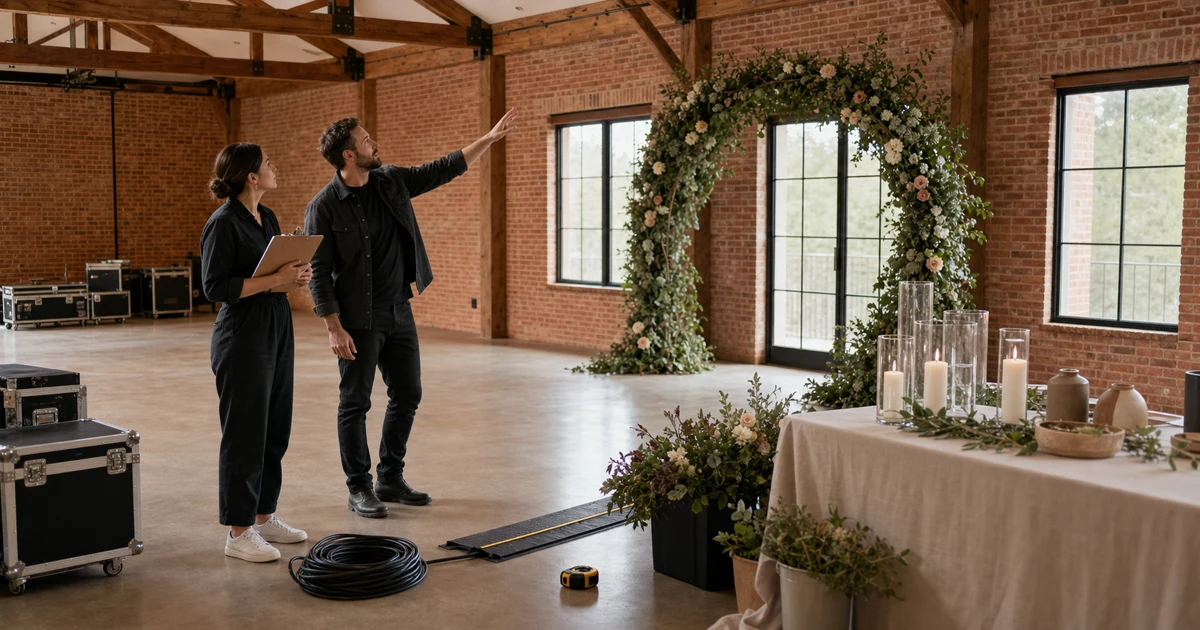
A wedding venue decor restrictions checklist should cover nine areas: attachments, flame, power, access, labor, included inventory, cleanup, outdoor use, and written approval. For every rule, record the source, the person who can approve it, the deadline, and what it changes in the design. Do this before paying for decor, not during setup.
The useful question is not simply, “Can we decorate?” It is, “Can this supplier install this item in this place, by this method, during our access window, and remove it before our contracted end time?” That version gives the venue something concrete to approve. It also gives your florist, rental company, lighting team, or extremely optimistic uncle a plan they can actually follow.
Start with a rule record, not a memory
Open the venue contract, current policy page, package inventory, and every relevant email. Highlight anything about decorations, fire, power, suppliers, insurance, access, setup, room changes, cleaning, or damage.
Then turn each rule into its own row. A note such as “no hanging” is not precise enough. Does it prohibit adhesives on windows, nails in walls, suspension from beams, ceiling rigging, or all of them? Can an approved supplier bring a self-supporting frame? Does venue staff have to use the ladder? The design consequence changes with the answer.
Use three statuses:
- Confirmed: the current written source answers the question.
- Needs written approval: the answer depends on the exact item, installation method, room, date, or supplier.
- Remove from the plan: the venue has clearly prohibited it.
Do not turn a verbal “should be fine” into a green light. Send a short recap after a call and ask the venue contact to confirm it.
Use this nine-part venue restrictions worksheet
Copy this table into your planning document. One area may need several rows. A suspended floral installation, a wall sign, and window drape should not share one generic attachments row.
| Area | What to confirm | What the answer changes |
|---|---|---|
| Attachments | Allowed surfaces and methods; weight or height limits; required rigging supplier | Backdrops, drape, signs, hanging flowers, lights, and anything fixed to the building |
| Flame | Candles, sparklers, burners, enclosure rules, permits, and seasonal limits | Candle type, quantity, placement, and whether a flameless alternative is needed |
| Power | Available outlets and circuits; adapters; cable covers; venue technicians; extra fees | Lighting, signs, audio, photo booths, catering equipment, and cable routes |
| Access | Loading route, parking, lifts, doors, setup start, removal window, and room turnover | Supplier arrival times, vehicle size, crew size, packaging, and installation sequence |
| Labor | Who may use ladders, rig items, move furniture, assemble decor, and reset the room | Supplier scope, venue labor fees, volunteer jobs, and the realistic setup plan |
| Included inventory | Exact tables, chairs, linens, stands, signs, lighting, staging, and quantities | What you can remove from quotes and what still needs a backup |
| Cleanup | Who removes decor, packaging, wax, water, flowers, and hired items; final move-out time | Teardown crew, supplier collection, waste plan, and overtime risk |
| Outdoor use | Wind, rain, ground protection, wildlife, fire rules, noise, and backup location | Securing methods, materials, weather plan, and items that cannot move indoors |
| Written approval | Required drawings, dimensions, material lists, insurance, and review deadline | Which items can be ordered and which must remain pending |
Add columns for the source, approver, deadline, owner, and design consequence. The last one prevents the sheet from becoming administrative trivia. If the venue says only its staff may use ladders, the consequence might be a labor request and fee, a lower freestanding design, or removing the item.
This checklist records permission. It does not replace structural, electrical, fire-safety, accessibility, insurance, or professional installation advice.
See how two real venue policies create different decisions
These examples show how to read a restriction, not what your venue allows. They come from two current first-party policy pages checked on July 28, 2026. Keep each rule attached to the venue that published it.
Hidden Barn Venue example
Hidden Barn Venue’s FAQ says decor that hangs from or attaches to walls, beams, ceilings, or structures, along with major installations, needs advance approval from venue management. Its FAQ also prohibits confetti and glitter. Candle and sparkler rules may change with the season and local fire regulations, so it directs couples to request the current answer before purchasing.
Those statements produce three different actions:
- put any attached or major installation into needs written approval;
- put confetti and glitter into remove from the plan;
- keep candles and sparklers pending until the venue confirms the current rule for the event date.
The same FAQ says tables and chairs are included in its packages, while linens are tied to the all-inclusive option. The planning action is to match the package and quantities in the contract before removing rentals from the supplier list.
Lynnwood Event Center example
Lynnwood Event Center’s wedding guidelines use a different rule set. They require review before banners are suspended, prohibit adhesive-mounted banners on walls or windows, and reserve ladder use for venue staff. Their candle rule requires an enclosure with the wick below its top and prohibits free-standing candles.
The guidelines also identify rooms that need special power adapters. They place decor assembly and cleanup on the client, require decor from outside companies to arrive and leave within the contracted event time, and require clients and suppliers to vacate by the agreement end time.
That becomes a supplier brief:
- route suspended-banner plans and any ladder work through the Event Manager;
- remove adhesive wall or window mounting from the design;
- specify a candle enclosure that matches the written requirement;
- confirm the room, adapter count, outlet locations, cable route, and fee;
- give setup and removal to named people, working backward from move-out.
Neither policy is “normal venue policy.” They are two examples of why your sheet needs a source column.
Send one approval email that is easy to answer
Do not email a mood board with “Is this okay?” Isolate the decision.
Use this template:
Subject: Written approval for [event date] decor plan
Hello [venue contact],
We are finalizing decor for [event] in [room or area] on [date]. Could you confirm this item in writing?
Item and location: [what it is and exactly where it will go]
Dimensions and weight: [measurements]
Support or attachment method: [freestanding or exact method]
Flame or power: [enclosure, wattage, outlet, cable route, or not applicable]
Installer: [supplier, insurance status, and any ladder or rigging access]
Timing and cleanup: [delivery, setup, removal, final move-out, and named owner]We have attached [drawing, product sheet, layout, insurance, or photos]. Please tell us which parts are approved, which need changes, and whether another venue representative must review the plan. We will not order or install pending items until we have that confirmation.
For several items, number them and ask the venue to reply with approved, changes required, or declined beside each number. Save the response with the latest worksheet rather than in a separate inbox archaeology project.
Convert every answer into a design decision
A finished restrictions sheet should change the decor plan. Review it before paying deposits and again before the final supplier briefing.
For each confirmed item, add the source and exact condition to the supplier brief. “Candles approved” is weaker than “enclosed candles approved in the reception room under the attached policy.”
For each item that needs written approval, assign one owner and one deadline. If the deadline passes, do not quietly promote it to confirmed. Use the pre-agreed alternative.
For each item you must remove from the plan, decide what visual job it was doing. If a suspended installation created height, consider a self-supporting feature only if the venue permits it. If candles created warm pools of light, ask about allowed lighting rather than buying a slightly different flame.
This is also the moment to revisit the venue-first wedding decor style scorecard. A style that depends on prohibited ceiling drape or a long installation window may no longer fit the room, however good the reference photo looks.
Finish with a one-page supplier handoff:
- approved items and exact conditions;
- pending items and approval deadlines;
- prohibited items and chosen alternatives;
- named setup and removal owners;
- load-in and move-out times;
- venue contact for day-of questions.
Where NuptiaAI fits after the rules are clear
NuptiaAI is an iPhone wedding-venue visualizer. It starts with a photo of the ceremony or reception space and lets you include special requests.
That makes it useful after the worksheet, when the brief can say something precise such as “freestanding backdrop only; no wall or ceiling attachment.” Treat the result as a concept to inspect, not an approval. A generated image can invent a ceiling fixing, hide a cable, narrow a walkway, move architecture, or add an item the venue has prohibited.
Audit the concept against the restriction sheet before sharing it:
- Did anything attach to a prohibited surface?
- Did a flame, cable, structure, or access route appear without approval?
- Did fixed doors, exits, windows, or venue furniture move?
- Could the proposed item stand and be installed by the approved method?
- Is every pending detail still labeled pending?
NuptiaAI cannot confirm permission, dimensions, electrical capacity, egress, installation safety, supplier availability, or final cost. The venue and qualified suppliers still make those decisions.
Frequently asked questions
What wedding decor restrictions should I ask a venue about?
Ask about attachments, flames, electricity, supplier access, allowed labor, included inventory, cleanup, outdoor conditions, and the written approval process. Make each question item-specific. A general answer about “hanging decor” may not settle whether a freestanding backdrop, window treatment, or approved ceiling rig is allowed.
Should venue decor approval be in writing?
Yes for any decision that affects an order, installation, supplier, fee, or safety condition. Record the item, location, dimensions, method, installer, timing, and cleanup owner. If approval came during a call or visit, email the summary and ask the authorized venue contact to confirm it.
When should I send the decor plan to the venue?
Send it before non-refundable orders and before the venue’s stated review deadline. Large structures, rigging, powered items, flames, outside suppliers, or anything requiring insurance often need more detail than table decor. Work backward from both the approval deadline and the supplier’s order date.
Can an AI visualization prove that decor is venue-safe?
No. It can help communicate a direction, but it cannot verify permission, attachment strength, power, fire rules, accessibility, measurements, or installation. Check the image for invented or prohibited details, then use drawings, product specifications, supplier documents, and written venue approval for the real plan.
Use the NuptiaAI wedding decor guides to shape the concept, then keep the approved restriction sheet beside every image and supplier brief.